Selfies, a self portrait taken with a cell phone camera and then uploaded onto a social media website, have become one of the biggest trends in our generation. But are selfies good or bad for our self-esteem?
 |
| The Obama girls pose for a selfie. |
If you search "#selfie" on Instagram, you come up with over one hundred million results. The history of the selfie goes back in time when painters have painted self portraits of themselves, eventually evolving with technology to be taken with smart phones.
I believe that selfies can be an empowering thing, something that builds your self-esteem and makes you feel good. I also believe there is a fine line between taking a selfie to share with friends and family about your activities, hobbies, interests or to show what you were wearing that day, for examples, and sharing a selfie for the attention it creates.
Guerrilla Feminism comments on their take opinion on selfies: "We are unapologetically pro-selfie feminists. We believe that selfies hold the radical potential for empowerment, self-representation, and visibility for marginalized folks." Yet, in their article they bring up an interesting critique on the "no make up selfie." They say they are not here to shame women who posts these photos of themselves not wearing makeup, they want to critique the movement behind it. The "no make up selfies" started as awareness for cancer. The blog post argues that wearing no makeup is not anywhere as terrible as having cancer. The trend started to 1. raise awareness for cancer, 2. encourage donations to cancer institutes, and 3. to show solidarity with cancer patients and survivors.
 |
| Queen Bey |
The blog post goes on to say that most people know what cancer is, so raising awareness isn't really doing much, and the people who post the pictures don't even mention the word cancer in the caption. If you want to donate, give money to a specific charity, and not some place that might use your donations on something other than research or the patients. The comparison between wearing no makeup and being a cancer patient is a brutal one. Guerrilla Feminism sums up the post by saying, "[Selfies] are a confident slap in the face of a patriarchal society that wants women, and other marginalized folks, to feel only shame and insecurity about our physical appearances. But please don't post your selfie in the name of cancer awareness, or expect to be lauded for your bravery."
I thought this article was interesting because it was all for the selfie culture, but not a specific type, the "no make up selfie," that rose up in the idea of something good. Many people have been involved with the "no make up selfie" trend, and I'm sure many people thought that their pictures were for a good cause. It's also insightful to listen to the other side of the idea, critiquing your activism.
In an example to show that selfies can be a bad thing, blogger and artist Lindsay Bottos decided to critique selfie culture and the online harassments she got because of the photos in the project Anonymous. Bottos recreated the original images that the harassing comments were addressing. She said comments would include threats of rape or violence, as well as many other cruel words and phrases about her.
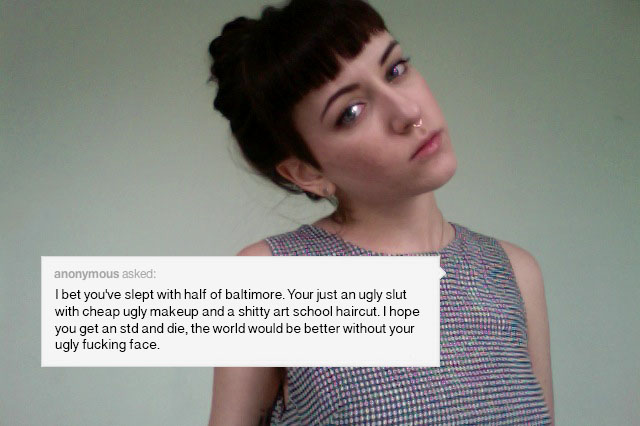

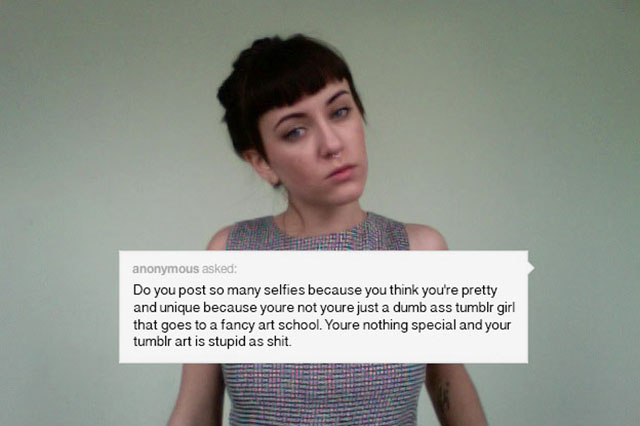
Bottos intent was to "demonstrate the cruelness of the comments while exposing and examining this phenomenon." These photos are so shocking, yet they are the reality of today's hateful anonymous generation. Kids and teenagers hide behind the computer screen to dominate someone else's self worth- they do this by finding something hurtful to say about the victim's "self-portrait." These comments can be very damaging to some of the receivers.
A journalist, Lauren Slavin, argues that selfies are bad because women and girls become objects in their portrayal in them. What started as a photo of the cleavage of a University of Kansas fan, became a wide phenomenon. Many cheering fans took photos of their cleavage in support of their college football team. Slavin questions their actions, commenting on their attention towards their breasts instead of their faces. Also, by "photographically cutting off their heads, women become manniquins for displaying a shirt and their breasts. And what are mannequins? Objects." Slavin argues that these selfies create a world of objectification.

Selfies can be a good thing because they make you less insecure by forcing you to become comfortable in your own skin. They are breaking down the barriers of what makes people beautiful- many people of all shapes, sizes, races, gender roles and social class are taking selfies. People like to document a good hair day or an outfit you love. Emily Cook, a 22 year old Instagram user, says that selfies give off a feel good vibe, "As vain as it may be, you know that if you're not feeling great, there's someone who will "like" your picture and tell you're pretty."
In a culture that reminds girls they are conceited or "thinks she's all that" because they show pride, selfies show the empowerment of pride. And people end up "liking" the photo in a way to agree with the girl. I think selfies are a good thing, agreeing with author of The Curse of the Good Girl: Raising Authentic Girls With Courage and Confidence, Rachel Simmons. Simmons says that selfies are a "tiny burst of girl pride."

I, personally, am a huge fan of selfies. I believe that selfies allow girls to actually feel good about their appearance instead of hating their bodies, as tends to to be the norm. One problem I do have with selfies is the need the poster feels for positive feedback. Many girls will delete selfies if they do not got enough likes or comments. I think that if a girl is confident enough to post a selfie, she should also feel confident enough to keep it up, no matter how many people like or comment on it.
ReplyDelete