Wednesday, April 30, 2014

No One Should Be Punished For Saying "No"

On Friday, April 25 in Milford, Connecticut, 16 year old Maren Sanchez was pushed down a flight of stairs and fatally stabbed in her high school. Her attacker was her ex-boyfriend, Chris Plaskon. Sanchez was "inclusive, kind, talented, and giving," reports The Huffington Post. So why would someone attack her? Plaskon wanted Sanchez to go to prom with him, but she said "no."

Maren Sanchez

Many media outlets are calling this violent crime a "dispute." A dispute, as defined by Merriam-Webster, is something arguable, or something that may not be correct. There is no way that this crime was a dispute because a dispute has to be two sided. If Sanchez said no, that ends the idea of going to prom with Plaskon. He could have chosen to accept that answer and found another date, yet he chose to savagely take a human beings life.

A Tumblr blogger, Seriously America, wrote about how society blurs the line of saying "no": "Maren Sanchez is dead because of male entitlement. Because we teach young men that they deserve the pretty girl as a prize for overcoming their life's obstacles. . . Maren Sanchez's murderer heard her refusal and felt that stabbing was his recourse."

The Woman Stats Project featured an article about media and violence against women. The article says that if the media repeatedly reports violence against women as a dispute, that becomes a norm and an expectation. The article also states that there are two common factors that "affect the base level of a person's acceptance of violence against women," gender and cultural norms. Cultural beliefs that include rigid gender norms have been linked to a tolerance of violence against women. The article provides ways to change this media representation. You can support movies and shows that show good interpersonal relationships and the negative effects of violence, avoid movies and shows that show rape in a positive light, and you can join many of the groups that oppose violence against women, such as Take Back the Night.

I believe that media representation on violence against women has become too extreme. Most media outlets do not report on the crime in the true way it happened, twisting the words to make it seem like it was the woman's fault for saying "no." This coverage of crimes is damaging to both men and women. Men see this coverage as if they do commit a crime like this, they might be let off a little easier, such as the Steubenville rape case. Women see this coverage and think that even if they do say "no," it's not going to be heard from the abuser.

Tuesday, April 22, 2014

Selfies

Selfies, a self portrait taken with a cell phone camera and then uploaded onto a social media website, have become one of the biggest trends in our generation. But are selfies good or bad for our self-esteem? 

The Obama girls pose for a selfie. 
If you search "#selfie" on Instagram, you come up with over one hundred million results. The history of the selfie goes back in time when painters have painted self portraits of themselves, eventually evolving with technology to be taken with smart phones. 

I believe that selfies can be an empowering thing, something that builds your self-esteem and makes you feel good. I also believe there is a fine line between taking a selfie to share with friends and family about your activities, hobbies, interests or to show what you were wearing that day, for examples, and sharing a selfie for the attention it creates. 

Guerrilla Feminism comments on their take opinion on selfies: "We are unapologetically pro-selfie feminists. We believe that selfies hold the radical potential for empowerment, self-representation, and visibility for marginalized folks." Yet, in their article they bring up an interesting critique on the "no make up selfie." They say they are not here to shame women who posts these photos of themselves not wearing makeup, they want to critique the movement behind it. The "no make up selfies" started as awareness for cancer. The blog post argues that wearing no makeup is not anywhere as terrible as having cancer. The trend started to 1. raise awareness for cancer, 2. encourage donations to cancer institutes, and 3. to show solidarity with cancer patients and survivors. 

Queen Bey

The blog post goes on to say that most people know what cancer is, so raising awareness isn't really doing much, and the people who post the pictures don't even mention the word cancer in the caption. If you want to donate, give money to a specific charity, and not some place that might use your donations on something other than research or the patients. The comparison between wearing no makeup and being a cancer patient is a brutal one. Guerrilla Feminism sums up the post by saying, "[Selfies] are a confident slap in the face of a patriarchal society that wants women, and other marginalized folks, to feel only shame and insecurity about our physical appearances. But please don't post your selfie in the name of cancer awareness, or expect to be lauded for your bravery."

I thought this article was interesting because it was all for the selfie culture, but not a specific type, the "no make up selfie," that rose up in the idea of something good. Many people have been involved with the "no make up selfie" trend, and I'm sure many people thought that their pictures were for a good cause. It's also insightful to listen to the other side of the idea, critiquing your activism. 

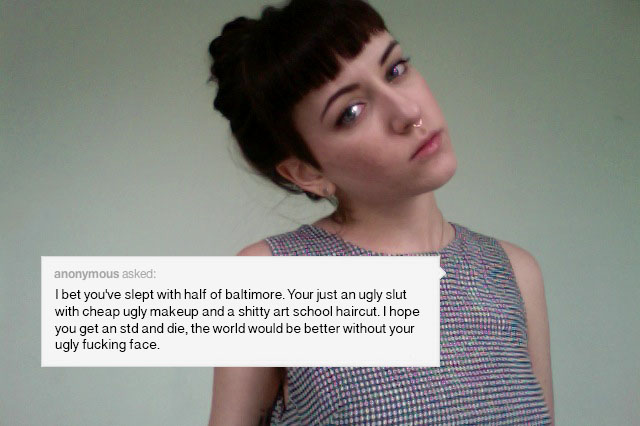
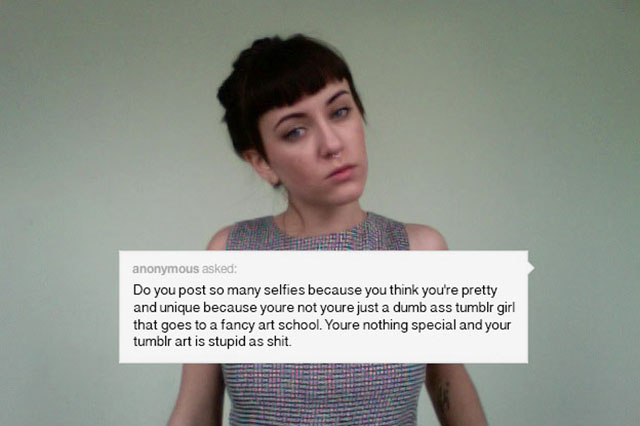
In an example to show that selfies can be a bad thing, blogger and artist Lindsay Bottos decided to critique selfie culture and the online harassments she got because of the photos in the project Anonymous. Bottos recreated the original images that the harassing comments were addressing. She said comments would include threats of rape or violence, as well as many other cruel words and phrases about her. 


 Bottos intent was to "demonstrate the cruelness of the comments while exposing and examining this phenomenon." These photos are so shocking, yet they are the reality of today's hateful anonymous generation. Kids and teenagers hide behind the computer screen to dominate someone else's self worth- they do this by finding something hurtful to say about the victim's "self-portrait." These comments can be very damaging to some of the receivers.

A journalist, Lauren Slavin, argues that selfies are bad because women and girls become objects in their portrayal in them. What started as a photo of the cleavage of a University of Kansas fan, became a wide phenomenon. Many cheering fans took photos of their cleavage in support of their college football team. Slavin questions their actions, commenting on their attention towards their breasts instead of their faces. Also, by "photographically cutting off their heads, women become manniquins for displaying a shirt and their breasts. And what are mannequins? Objects." Slavin argues that these selfies create a world of objectification. 


Selfies can be a good thing because they make you less insecure by forcing you to become comfortable in your own skin. They are breaking down the barriers of what makes people beautiful- many people of all shapes, sizes, races, gender roles and social class are taking selfies. People like to document a good hair day or an outfit you love. Emily Cook, a 22 year old Instagram user, says that selfies give off a feel good vibe, "As vain as it may be, you know that if you're not feeling great, there's someone who will "like" your picture and tell you're pretty." 

In a culture that reminds girls they are conceited or "thinks she's all that" because they show pride, selfies show the empowerment of pride. And people end up "liking" the photo in a way to agree with the girl. I think selfies are a good thing, agreeing with author of The Curse of the Good Girl: Raising Authentic Girls With Courage and Confidence, Rachel Simmons. Simmons says that selfies are a "tiny burst of girl pride." 

Tuesday, April 15, 2014

The Problems With Women's Magazines

I enjoy reading the articles in the CosMarieGlamVogBazElle magazines from time to time, especially at the beach because it's something to do. I have noticed my inner hatred towards them building up, so I started to really pinpoint the issues that mainstream magazines have on our culture.


1. They have unrealistic ideas about the normal human body. These women's magazines show many models wearing a dress size that is a zero or a double zero. The average woman in the United States weights about 166.2 pounds. These ridiculous photos of overly skinny women isn't what young girls learning about their bodies should be looking at. (Note: I am not putting down naturally skinny women; I think all sizes and shapes should be praised.  My problem is with models who diet so heavily that they weigh 90 pounds and are 5'10- 6'0 in height.) Another problem was when Cosmopolitan put out this photo of a normal looking model, claiming she was plus size. In today's modeling culture, the model would be considered heavy, although I think that's crazy. I think that normal body types should have a rise in the modeling agency, similar to Dove's campaign for Real Beauty. With young girls reading these magazines, it's hard for them not to think if something is wrong with their body. According to the National Association of Anorexia Nervosa and Associated Disorders, nearly 70 percent of young girls in grades five through twelve said magazine images influence their ideals of a perfect body. About 40 percent of first to third grade girls want to be thinner! It's studies like these that really shine the light onto media's control over young women.

On the left, a "pluse size" model is advertising a swimsuit.
On the right, a "normal size" model is posing for photographs.  

2. These fashion magazines try to relate to real women, yet they fall short of the representation of the population. Real working class women normally have college loans, credit card bills, mortgages and car payments to pay off. They do not have time nor money to buy Salvatore Ferragamo heels for $1,150. (If you can afford these, I envy you!) The editors of Cosmopolitan, Elle, Glamour, and Marie Claire set up their pages of the magazine to be about clothes, hair, beauty and advice on decluttering and destressing your life. I enjoy being up to date on the new fashion trends, but I don't always want to read about the new clothes that are way out of my college student budget. I also have a problem with magazines glamorizing domestic violence such as these ads:
A 2006 Jimmy Choo advertisement, showing a women in the
trunk of a car, and a man "digging her grave."

From 12 magazine's article "Victim of Beauty," shows the glamorization
of domestic violence. 
These advertisements, and many others, show just how serious mainstream media is getting with the violence against women in promoting their products. I would never buy Jimmy Choo shoes from the above advertisement. These ads don't even make it clear what they are even selling! In the "Victim of Beauty" article, they try to say that women are victims of how high the beauty standards are becoming. It's not that high to were a woman gets burned by acid, she has a slit throat, or has a black eye. These notions are very extreme and exploits the real victims of domestic violence, all the while normalizing our views on violence images.

3. Magazines need "photogenic ladies to slot into pre-written narrative." Jezebel featured an article, "The Real Reason Women's Magazine's Suck," which talks about examples like Cosmopolitan'Confession stories or Glamour's "The Best Sex Secret I've Never Told Anyone." These stories are already thought up from the editors. The process of this goes as follows: an editor will pick a topic (from example in the article) how a certain Bad Disease changed a woman's life. These editors want stories about how a woman's "distant marriage was made closer" by the Bad Disease, or the woman "embraced alternative treatments, but not too much, so she didn't seem like a wacko." These story lines are made up, invented, and the journalists have to go out to interview real women, who have something similar to say. A journalist commented on this process: "I am asked to provide photos. If the woman has an undesirable quality- like, say, she's a lesbian- she's disqualified." These stories are harmful because of the fictional tales. These stories skew the real life stories
of very real women because they are made up.


4. Cosmopolitan's claim to be "for women by women" is false. This claim bothers me because it should really be "by men for women." The articles topics included in Cosmopolitan are for a man's entertainment: articles about how to please a man during sex, what to wear so you can get him to like you, and cookie-cutter portrayals on sexuality. Women's magazines contribute to the idea that men expect and prefer thin women. As an example of ideas for a man's entertainment, Cosmopolitan featured an article called "7 Cool Tricks You Need Now." It seems like the article will be about tips for women to make them feel good about themselves, and not for women to do for others. The article goes on to say that these tricks will make you feel good about showing them off- going back to the entertainment argument where you are showing off something to entertain another. Another Cosmopolitan article, "Fun Little Tricks Guys Love," told women to use thong underwear to tie their hair back. What?! 


Some people have critiqued the magazine industry in satires like Overanalyzing Magazine and in a mock magazine cover campaign aired during International Women's Day. 


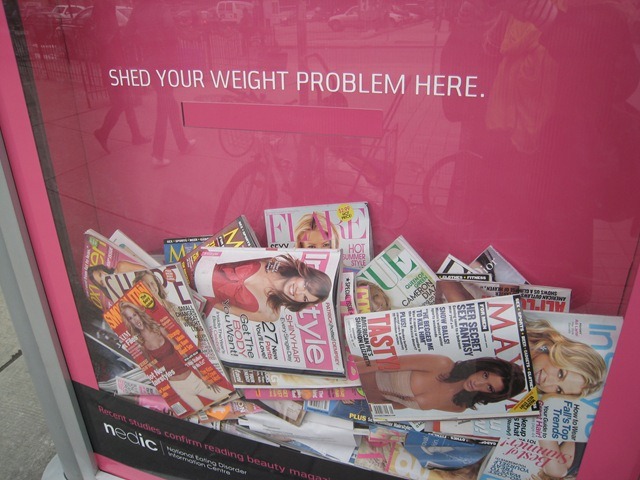
Another campaign, held by the National Eating Disorder Information Center, asked women what they thought about women's magazines. The women could "shed their weight problem" in the box provided. I feel like this advertisement shows a very bold statement, and hopefully creates more discussion on the mainstream media's control on women's magazines.   



Tuesday, April 8, 2014

Unwanted Body Hair?

Veet, a hair-removal brand, has new commercials that make a claim that is so absurd: if women don't shave their legs or armpits, they become men! These commercials really bother me because Veet is essentially preying on the insecurities of women to sell products. I know plenty of men that shave and wax their body hair, and yet society still says that is okay. But more importantly, are the men who shave and wax women? No, so why do women have to be men if they don't shave? I'm calling bullshit on this commercial. 


The Veet commercials - which show a lover, a taxi driver, a paramedic, and a nail technician disgusted with a girl who has hair growing back 12 hours after she shaves - have a slogan screaming "Don't risk dudeness. Feel womanly around the clock." Other slogans say "Never again say 'But I just shaved yesterday!'. . . Don't manhandle your underarms- wax the dudeness away!. . . Embrace your smooth feminine side and never be caught off gurad with VEET."

An Ad Week article brings up five reasons why these Veet commercials are wrong: 1. It shames women by telling them they are less womanly if they have body hair on their legs and armpits. 2. It's mildly homophobic. In one commercial, the two lovers are in bed, and the woman- who didn't shave- became a man. Her boyfriend is horrified that he woke up next to a man. 3. It's dumb because of the exaggerated way the taxi driver leaves the hairy woman and because they use the word "dudeness". 4. It's empirically wrong because no woman "turns into Chewbacca overnight." 5. It makes fools of both men and women. "The burly guy in the nightie speaks in a baby-girl voice, doing neither gender any favors." These main points add a lot of insight on how ridiculous these ads have become.

I agree with one blogger that commented on Veet's commercials stating: "I generally like having freshly shaven legs and armpits. . . But there is seriously nothing that makes me want to let my naturally robust and thick body hair run wild more than someone saying that I need to be hairless to be (attractive as) a woman- especially if that someone is a company that is looking to profit by stoking anxiety and shame about gendered beauty norms."

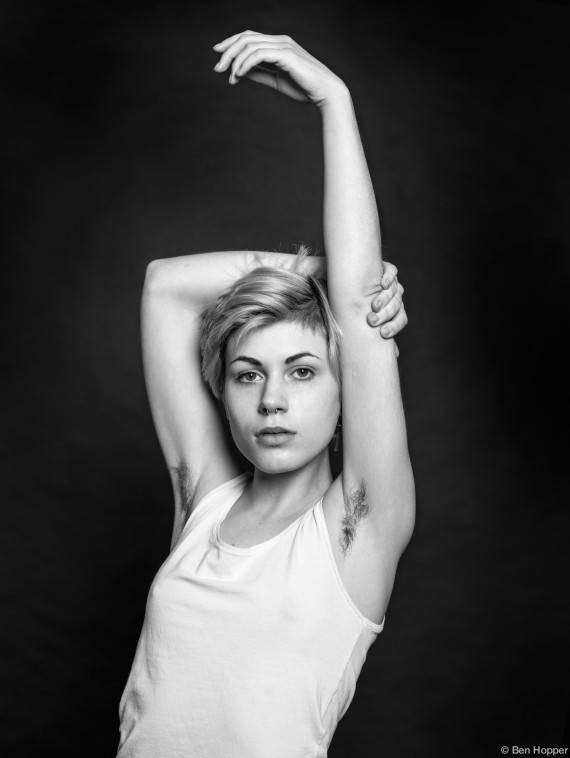
A Huffington Post article talks about an artist that shows how body hair can be beautiful. Ben Hopper, a photographer, started "Natural Beauty" in 2007, taking pictures of willing models showing off their armpit hair.


The article goes on to say that his project plays on the "fact that armpit and body hair have been stigmatized [in the United States]." You very rarely see a women embracing her body hair, she is more like to be shamed away from showing it. Ben Hopper explains what he wants people to get out of the project: "I don't want to say that I want women to start growing their armpit hair. I just think that it's a possibility and people shouldn't dismiss it. I'd like people to question [beauty standards], the whole thing."

I think what is more important than holing yourself up in the bathroom, is to focus on your career, education, and other hobbies that interest you. I want to better myself and not just my looks. Frankly, I don't really care if I'm stubbly, as long as I got to do something more important.

Thursday, April 3, 2014

Sexual Assault Awareness Month

April is Sexual Assault Awareness Month (SAAM). According to Rape Abuse Incest National Network (RAINN), "one in six American women has been the victim of an attempted or completed rape in her lifetime." Because the majority of victims are female (about 17.6% are women, 3% are men), women are most likely going to advocate the elimination of sexual assault.

Recently, I saw an article on Ms. Magazine's website about men being proactive in anti-sexual assault causes. 


The article goes on to say that "there is a new kind of fantasy. It's about a new kind of man." The New Men stand by the women on school campuses demanding justice. These men are disgusted in rape culture and slut shaming. They start to call their friends out on behaving badly towards women. The New Men will start with the frat parties, then sports teams, coaches, professors- "they challenge all men to be better men." 

I think this idea of men standing up to the victims of assault is really great. Now instead of just women, we have men to help this fight that seems never ending. There are events that involve men in ending rape, sexual assault and gender violence, such as Walk a Mile in Her Shoes


By getting the message across to all people- no matter race, class, gender, or background- it raises awareness, and it will lead to the elimination of sexual assault. Yet, it is crucial to start this awareness on college campuses. 

Harvard published a story written by a student, who was raped on campus. The student asked for the perpetrator to be moved out of her dorm building, so she wouldn't have to see him every day. Harvard could not do anything because "[the] assailant may not have violated the school's [sexual assault] policy in the student handbook." This policy is twenty years old. The student goes on to say that she developed depression and anxiety because of the rape and the fact that the college did nothing to help her. 

There are many other cases like this: Amherst, Steubenville, Emerson, Swarthmore, Occidental, as well as 41 other colleges. These stories are so sad, because who will help the victims, if not the people in charge? Men are the majority of the perpetrators, so the idea of the New Men coming in and telling their friends they are acting like bad behaved bigots might work. Rallies, speeches, and other events held by men and women in ending sexual abuse on campuses is another way to get the word out. 

What are your thoughts on ending sexual assault on college campuses? Have you or someone you know attended Walk a Mile in Her Shoes? 

For more information about SAAM and the events going on this month, visit the National Network to End Domestic Violence website

Sunday, March 23, 2014

Mixology


I thought I would watch Mixology, a new TV show on ABC. The Hollywood Reporter's article describes the show as, "[Revolving] around ten people in one bar on one night [and] breaks up their various pursuits to get laid." I watched the Pilot, and I now see why the reviews say the show is so bad. I thought it seemed somewhat promising, but the misogynistic "humor" ruined it for me. You will hear "jokes about rape, about women being slapped by men, women who men think are whores and one-liners like this: 'Look at that chick throwing up. I'm going to bang her out,'" according to the Hollywood Reporter's article. This description is very accurate. 

I had a major problem with the rape joke, first of all: "You are a Viking!" one character says to another. "You rape and pillage and take what you want! Obviously, don't rape her." This line came as the form of advice from one friend to another friend, who is going through a breakup. 

Next, there was this picture, advertised on the Mixology ABC Twitter page:


I wear heels sometimes, yet I'm not looking to have sex every night I go out. I have friends who wear flats because we go bar hopping in Annapolis. Cobble stones, drinking and heels do not mix, plus it's very uncomfortable. I think this advertisement for the show really degrades women: they will either be ignored because they are wearing flats or they are slut for wearing really high heels. 

Yet, to counter argue my point, I found an article where the author loved the show. The author writes about the line, "Girls who wear flats are never trying to get laid. . ." pictured above. She says: "I laughed at that. There's a reason I don't wear six-inch high stilettos when I go out to a bar. I don't want skeevy guys like [the one who made the comment] hitting on me." I though her point was valid, because that does happen, I just think that women shouldn't have to worry about what they are wearing attracting unwanted attention. 

In a Flavorwire article, the author explains why they thought the show was infuriating: 
                    
                    "It is exhausting to listen to someone repeatedly get called a bitch (both the 
                    men and the women, so at least there’s some kind of equality?), to heard the 
                    phrase “smash it out” for the millionth time (no one on this show has sex; 
                    they “bang” and “smash”), and to listen to men describe their mission to find 
                    very drunk girls to go home with (but not girls in flats — “the higher the heels, 
                   the looser she feels!”). It is exhausting to hear a woman claim that “real” men 
                   are the Don Draper types who would smack her in the mouth if she sassed."

I think this description really points out some very true observations. The show begins to repeat itself, because I don't think you an go very far with the idea of one bar, one night and ten people trying to "smash." I think the show's portrayal of women and men are limited because most of the characters are undeveloped and stereotypical. TV shows don't always have to be about something to make you think, but if you're going for comedy, at least make it funny. I'm tired of TV shows slut shaming women, approving of rape culture, and saying that men who cry are weak and unlikable. 

Friday, March 7, 2014

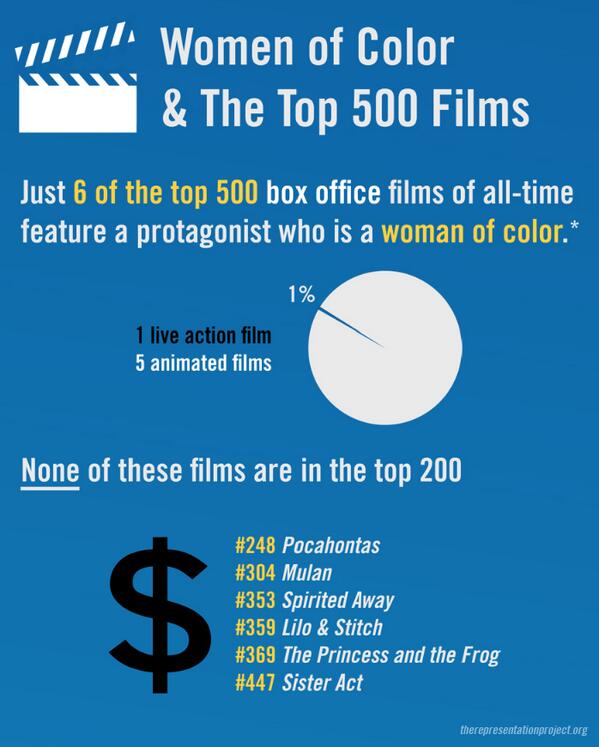
Lack of Women of Color at Oscars

Embedded image permalink


This infographic says a lot about movies being produced, not only in present time but also many years before this. Why are there so few women of color in movies and winning awards at the Oscars? 

Directing away from women of color for a moment, two men of color made history at the Oscars in 2014. The Daily Beast reported that Steve McQueen was the first black director to win an Oscar (Best Picture, 12 Years A Slave), and Alfonso Cuaron was the first Latino director to win an Oscar (Best Director, Gravity). To me it is so shocking that a black or Latino director hasn't won an Oscar until this point. Yet I would like to see more women of any color winning these titles as well. 


The first black woman to win Best Supporting Actress was Hattie McDaniel (Gone With the Wind) back in 1940. She couldn't attend Gone With the Wind's movie premiere because Jim Crow laws forbid it.  The Grio's article discusses the question, "Have things changed for women of color?" 


The answer is yes and no. Halle Berry was the first black woman to win the Best Actress title in 2002. Lupita Nyong'o, who won this year's Oscar for Best Supporting Actress is one of seven. The Academy Award voters remained primarily white men, so the change is slow moving, but some may argue that any move in this direction is a good one. 

I believe that the diversity of the Academy Award voters needs a huge change. There needs to be men and women of many backgrounds on the panel. Typically in the voting process, the voters will chose the happy, feel-good movie of the year. I think that the voters should take risks, and chose films that were not necessarily happy but deserve an award.