I enjoy reading the articles in the
CosMarieGlamVogBazElle magazines from time to time, especially at the beach because it's something to do. I have noticed my inner hatred towards them building up, so I started to really pinpoint the issues that mainstream magazines have on our culture.
1. They have unrealistic ideas about the normal human body. These women's magazines show many models
wearing a dress size that is a zero or a double zero. The average woman in the United States
weights about 166.2 pounds. These ridiculous photos of overly skinny women isn't what young girls learning about their bodies should be looking at. (Note: I am not putting down naturally skinny women; I think all sizes and shapes should be praised. My problem is with models who diet so heavily that they weigh 90 pounds and are 5'10- 6'0 in height.) Another problem was when
Cosmopolitan put out
this photo of a normal looking model, claiming she was plus size. In today's modeling culture, the model would be considered heavy, although I think that's crazy. I think that normal body types should have a rise in the modeling agency, similar to Dove's campaign for
Real Beauty. With young girls reading these magazines, it's hard for them not to think if something is wrong with their body. According to the
National Association of Anorexia Nervosa and Associated Disorders, nearly 70 percent of young girls in grades five through twelve said magazine images influence their ideals of a perfect body. About 40 percent of first to third grade girls want to be thinner! It's studies like these that really shine the light onto media's control over young women.
 |
On the left, a "pluse size" model is advertising a swimsuit.
On the right, a "normal size" model is posing for photographs. |
2. These fashion magazines try to relate to real women, yet they fall short of the representation of the population. Real working class women normally have college loans, credit card bills, mortgages and car payments to pay off. They do not have time nor money to buy
Salvatore Ferragamo heels for $1,150. (If you can afford these, I envy you!) The editors of
Cosmopolitan,
Elle,
Glamour, and
Marie Claire set up their pages of the magazine to be about clothes, hair, beauty and advice on decluttering and destressing your life. I enjoy being up to date on the new fashion trends, but I don't always want to read about the new clothes that are way out of my college student budget. I also have a problem with magazines glamorizing domestic violence such as these ads:
 |
A 2006 Jimmy Choo advertisement, showing a women in the
trunk of a car, and a man "digging her grave." |
 |
From 12 magazine's article "Victim of Beauty," shows the glamorization
of domestic violence. |
These advertisements, and
many others, show just how serious mainstream media is getting with the violence against women in promoting their products. I would never buy Jimmy Choo shoes from the above advertisement. These ads don't even make it clear what they are even selling! In the "Victim of Beauty" article, they try to say that women are victims of how high the beauty standards are becoming. It's not that high to were a woman gets burned by acid, she has a slit throat, or has a black eye. These notions are very extreme and exploits the real victims of domestic violence, all the while normalizing our views on violence images.
3. Magazines need "photogenic ladies to slot into pre-written narrative."
Jezebel featured an article, "
The Real Reason Women's Magazine's Suck," which talks about examples like
Cosmopolitan'
s Confession stories or
Glamour's "The Best Sex Secret I've Never Told Anyone." These stories are already thought up from the editors. The process of this goes as follows: an editor will pick a topic (from example in the article) how a certain Bad Disease changed a woman's life. These editors want stories about how a woman's "distant marriage was made closer" by the Bad Disease, or the woman "embraced alternative treatments, but not too much, so she didn't seem like a wacko." These story lines are made up, invented, and the journalists have to go out to interview real women, who have something similar to say. A journalist commented on this process: "I am asked to provide photos. If the woman has an undesirable quality- like, say, she's a lesbian- she's disqualified." These stories are harmful because of the fictional tales. These stories skew the real life stories
of very real women because they are made up.
4.
Cosmopolitan's claim to be "for women by women" is false. This claim bothers me because it should really be "by men for women." The articles topics included in
Cosmopolitan are for a man's entertainment: articles about how to please a man during sex, what to wear so you can get him to like you, and cookie-cutter portrayals on sexuality. Women's magazines contribute to the idea that
men expect and prefer thin women. As an example of ideas for a man's entertainment,
Cosmopolitan featured an article called "7 Cool Tricks You Need Now." It seems like the article will be about tips for women to make them feel good about themselves, and not for women to do for others. The article goes on to say that these tricks will make you feel good about showing them off- going back to the entertainment argument where you are showing off something to entertain another. Another
Cosmopolitan article, "Fun Little Tricks Guys Love," told women to use thong underwear to tie their hair back.
What?!
Some people have critiqued the magazine industry in satires like Overanalyzing Magazine and in a mock magazine cover campaign aired during International Women's Day.
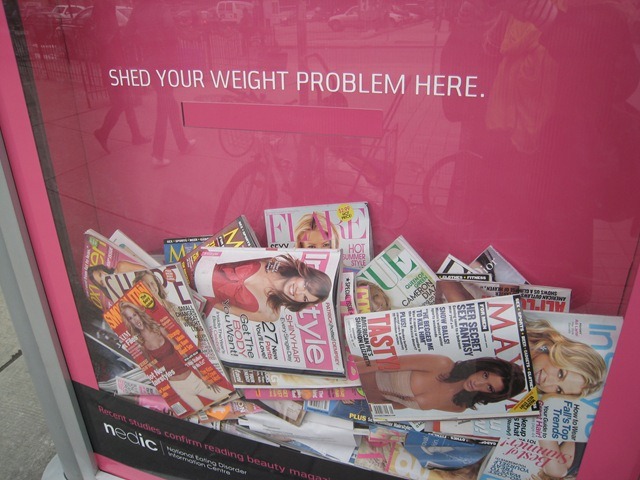
Another campaign, held by the National Eating Disorder Information Center, asked women what they thought about women's magazines. The women could "shed their weight problem" in the box provided. I feel like this advertisement shows a very bold statement, and hopefully creates more discussion on the mainstream media's control on women's magazines.